

Search is undergoing a profound shift in 2026.
Users no longer rely on traditional “blue links.” Instead, they increasingly turn to AI-powered answer engines: ChatGPT, Perplexity, Google’s SGE, Bing Copilot, Gemini, and emerging AI browsers. These tools do not display traditional rankings. Instead, they internally evaluate and prioritize sources during retrieval and synthesis to construct an answer. This shift demands a new discipline: Generative Engine Optimization (GEO). GEO is not a replacement for SEO; it’s a strategic extension that ensures your brand is referenced, cited, or included in AI-generated answers.
At the heart of GEO lies an understanding of how generative engines process information. As mentioned, these systems do not rely solely on the traditional ‘crawl → index → rank’ model; they layer semantic retrieval and generative synthesis on top of indexed content. The more a brand understands this internal pipeline, the better it can align its content to become a preferred source. Below is a deep technical breakdown of how generative engines actually work step by step.
Below is a deep dive into how Generative Engine Optimization works, why it matters, and how marketers can optimize for this new landscape.
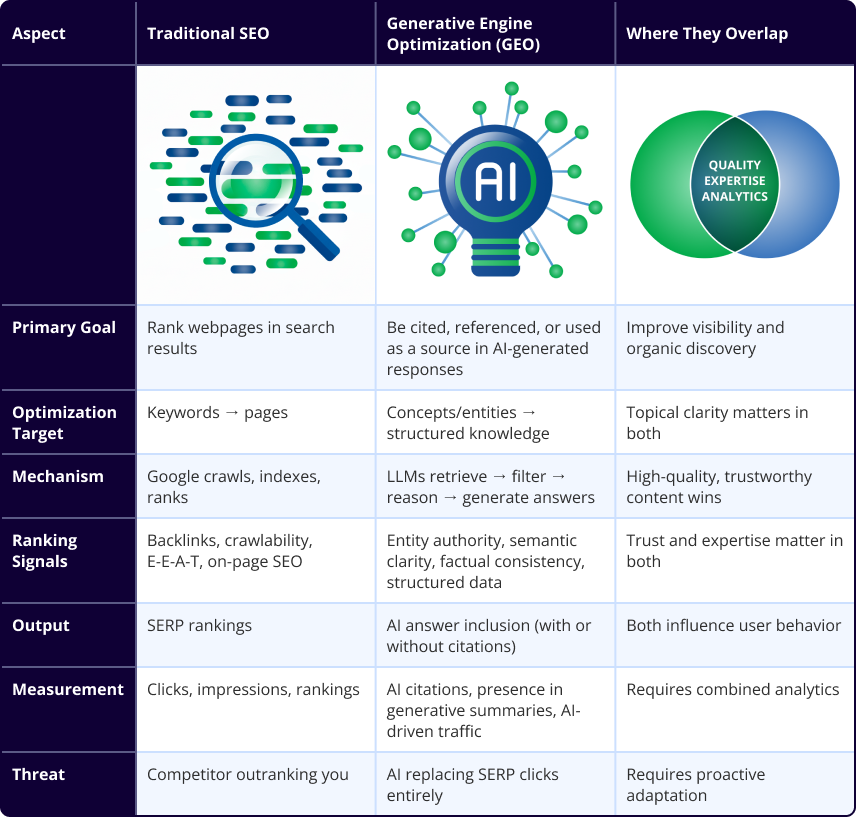
SEO vs GEO: Differences and Similarities
Generative engine optimization (GEO) ensures that a brand’s products, services, and content are structured and phrased in a way that makes them more likely to be recommended or cited by AI chatbots such as ChatGPT, Google Gemini, Perplexity, and other generative AI tools. The concept of creating content that focuses on experience, expertise, authoritativeness, and trust, otherwise known as E-E-A-T content, is well-established. But that’s just the tip of the iceberg.
Before you can properly understand the mechanics of GEO, it’s essential to see how it differs from traditional SEO.
Pro Tip
SEO gets you ranked. GEO gets you referenced. As search shifts from “lists of links” to “direct answers,” GEO becomes indispensable.
Why Structured Data Matters in a Generative Search Environment
At a foundational level, generative engines rely on clarity. They don’t “understand” content the way humans do, so they depend on structured signals to know what something means. Structured data provides those signals. Schema markup is a standardized way of labeling information so machines can identify what things are, not just read the words describing them. It explicitly defines entities (such as a person, product, article, or organization), how those entities relate to each other, and the purpose of the content.
In a GEO context, structured data:
- Reduces ambiguity during retrieval
- Improves entity recognition
- Helps AI systems segment and quote information accurately
While not every generative engine directly consumes schema markup, structured data influences the search indexes and knowledge layers these systems rely on. In practice, it increases the likelihood that content is retrieved, understood correctly, and safely incorporated into generated responses.
Citations as a Signal of Trust and Verifiability
In generative search, citations function as a proxy for confidence. When AI systems assemble an answer, they favor sources that can be verified, defended, and traced back to authoritative origins. Content that is grounded in data, standards, and primary sources will consistently outperform unsupported opinion.
From a GEO perspective, citations matter because they:
- Reduce model uncertainty
- Strengthen factual grounding
- Enable attribution inside AI-generated responses
This shifts content strategy away from simply utilizing persuasive language and toward evidence-backed explanations. Clear definitions, sourced statistics, and transparent methodologies make content easier for AI systems to trust and reuse. To put it simply, citations are no longer just academic best practice, they are a visibility mechanism.
The Role of Reddit and Reviews in AI-Generated Answers
Generative engines do not rely exclusively on polished, first-party content. They increasingly incorporate community-driven sources to understand real-world experience and sentiment. Platforms like Reddit provide dense, experience-based discussion that helps models identify patterns: what works, what doesn’t, and where tradeoffs exist. Reviews serve a similar role, offering structured feedback that can be aggregated into pros, cons, and consensus views.
For generative systems, these sources act as a counterbalance to vendor claims. They help validate – or challenge – official narratives.
As a result, AI-generated answers often reflect not just what brands say about themselves, but what users collectively say about them. This makes community discourse and review ecosystems an important component of GEO, even though they sit outside traditional on-page optimization.
GEO as a Shift From Rankings to Reference
The defining characteristic of GEO is not placement, but inclusion. Traditional SEO asked whether a page could rank highly enough to earn a click. GEO asks whether a source is credible enough to be used inside an answer. Visibility is no longer about position—it’s about participation.
That participation depends on trust signals that machines can verify. Generative engines favor sources that are structurally clear, factually grounded, and consistently validated across the web.
That trust is built through a combination of:
- Machine-readable structure
- Verifiable, cited claims
- Consistent third-party and community validation
Without these elements, content may be visible… but it won’t be referenced.
Why GEO Changes How Content Is Designed
GEO fundamentally alters how content must be written and structured. It rewards information that is explicit rather than implied, structured rather than abstract, and informative rather than promotional. Generative systems extract meaning, not messaging. They favor explanations over slogans, context over keywords, and evidence over persuasion. Content designed for GEO anticipates how an AI will parse, summarize, and attribute information.
This doesn’t eliminate creativity or brand voice. It raises the bar for clarity and credibility.
GEO Is Central to Modern Organic Visibility
Search is moving from discovery through lists to discovery through synthesis. SEO (Search Engine Optimization) still ensures technical accessibility and human usability, but GEO determines whether content becomes part of the answers themselves.
To compete in this environment, brands must focus on:
- Building strong, unambiguous entities
- Creating semantically rich, structured content
- Maintaining factual accuracy and consistency
- Optimizing for retrieval, not just rankings
- Monitoring presence inside generative responses
Organic visibility now depends on whether content can be interpreted, trusted, and recomposed by AI systems.
GEO Is the New Foundation of Findability
Generative Engine Optimization reflects a broader reality: AI systems are becoming the primary interface between people and information. In this environment, visibility is no longer earned by being found, it’s earned by being used.
Structured data, citations, and community validation have become more than tactical enhancements. They are foundational signals that determine whether content participates in knowledge creation. GEO is not a future concept or a passing trend. It is already shaping how information surfaces today. Brands that master it now will define visibility in AI-driven ecosystems for years to come.
If you’re ready to implement GEO but aren’t sure where to begin, inSegment can help.