Any time a new channel arrives, the conspiracies begin. Social media was “just for kids.” Mobile sites were “an unnecessary extra.” Now it’s generative engine optimization’s moment in the spotlight, and the myths are already piling up.
GEO, the practice of getting your business mentioned and recommended in AI-generated answers, has transitioned from a niche talking point among marketing experts to a line item in most marketing budgets in a little under two years. This speed has left the door open to guesswork and unsubstantiated claims.
Some businesses are spending money on GEO tactics that don’t work, and others are simply ignoring the channel entirely based on assumptions that no longer hold. Despite what some speculators say, the cost of getting GEO wrong is real. When a customer asks ChatGPT, Gemini, or Claude who to call, there’s no page two to fall back on. You’re either cited in the answer, or you’re not.
Here are five of the most common GEO myths that are doing the rounds in 2026, and what the evidence actually says.
Why GEO myths matter more than you think
AI discovery is no longer a future trend; it’s here. Adobe Digital Insights analyzes more than a trillion visits to U.S. retail sites, and the latest report found that traffic from AI sources grew 1,219% between October 2024 and July 2026.
Growth at that rate attracts noise. New tools, new acronyms, and new “AI-ready” services appear every month, and unfortunately, many of these services are built on half-truths. Before you invest time or budget in GEO, it’s worth separating what genuinely moves the needle from what simply sounds convincing.
Myth 1: GEO replaces SEO
It’s easy to see why this myth caught on. If customers are asking AI tools instead of scrolling search results, it’s not unreasonable to assume the old playbook is outdated.
But that’s not true.
In May 2026, Google published its first official guide to optimizing for generative AI features in Search, covering both AI Overviews and AI Mode. The guide builds upon Google’s existing material on AI for your website, and the message was clear: good SEO is the foundation of good AI visibility. Crawlable pages, helpful content, and a technically sound website are still paramount.
Rather than replacing SEO, GEO has changed the emphasis. AI tools lean more heavily on what the wider web says about you, rather than just your own website. Think of GEO as SEO with a bigger footprint, rather than a substitute for it.
Myth 2: You need special “AI tricks” to get noticed
AI-specific schema. Bite-sized chunks of content. llms.txt files. Pages rewritten in a special “AI style.” There is an entire market that’s grown up around these tactics, and many businesses still assume they’re essential.
Google, on the other hand, disagrees. Its guidance states that none of these give a special advantage in its AI features, and states that it reads your normal web pages the same way it always has. On other platforms, including ChatGPT and Perplexity, these signals may be weighted differently, but there’s no secret file or hidden markup that guarantees a mention anywhere.
Businesses that get recommended publish genuinely useful content and include only accurate information. It’s less exciting than a hack, but it actually works.
Pro Tip
Before paying for any “AI optimization” add-on, ask your vendor to show you any evidence that a specific tactic increases AI mentions. If their answer is vague, keep your budget.
Myth 3: AI search is too small to worry about
On the surface, this isn’t a terrible take. For most websites, AI tools still send only a small slide of overall traffic, so it can be tempting to kick the proverbial can down the road.
That conclusion misses two things. First, the visitors who do arrive are unusually valuable. In July 2026, Adobe found that AI-referred retail visitors converted at a rate 60% higher than non-AI traffic, and spent more per visit. This is likely because these clients have had their shortlist given to them.
Don’t be tricked by underwhelming figures. Much of AI’s influence happens without a click at all, which means it never shows up in your analytics.
Myth 4: Only big brands get recommended
Scores of smaller businesses assume AI tools default to household names, so they don’t bother competing.
However, when Ahrefs analyzed 75,000 brands, the strongest predictor of appearing in Google’s AI Overviews was branded web mentions, followed by backlinks, while paid factors like branded ad spend barely registered.
Put simply, AI visibility follows how often—and how credibly—your business is talked about across the web. A local firm that’s consistently mentioned positively in reviews, business directories, local press, and community forums will earn its place alongside bigger competitors.
Myth 5: Once you’re in, you’re in
In traditional search, a page that ranks well tends to stay there for a while, and many businesses assume AI answers behave the same way.
They don’t.
A study by SparkToro and Gumshoe.ai found less than a 1-in-100 chance that ChatGPT or Google’s AI would return the same list of brands across repeated responses to the same prompt. The chance of the same list in the same order was even lower.
That makes “ranking first in ChatGPT” a largely meaningless goal. What matters much more is how often you appear across many answers over time. Because AI tools keep refreshing their sources, this frequency can slip if you stop feeding them fresh, accurate, positive signals.
Pro Tip: Don’t judge your AI visibility on one single search. Ask the same handful of customer questions across several AI platforms each month, and identify how often you’re mentioned rather than where you’re placed.
GEO myths vs. reality at a glance
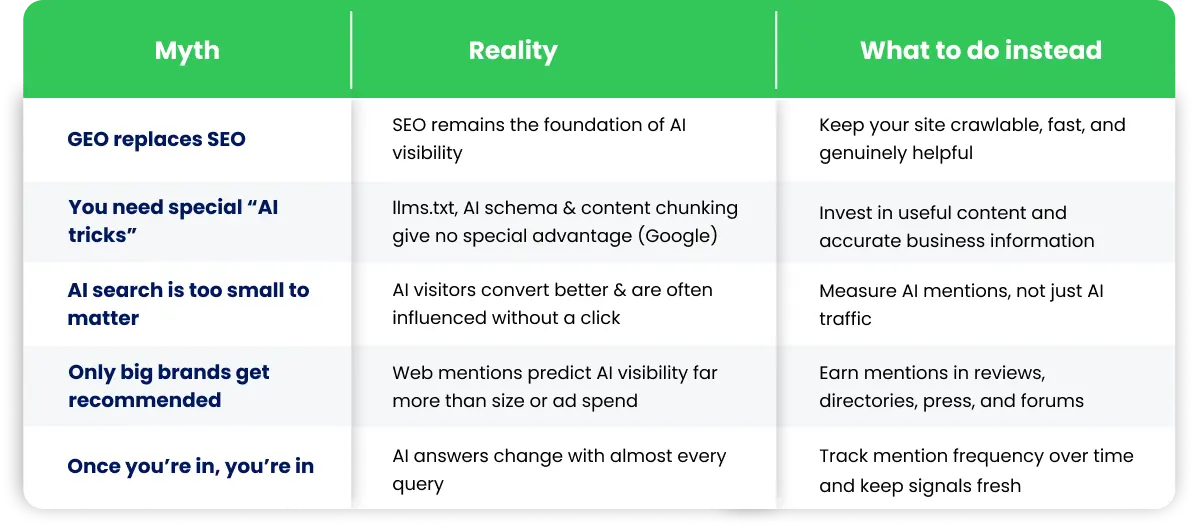
Building a GEO strategy on facts, not myths
Now that the myths have been busted, it should be clear that a sensible GEO strategy is not going to look to different to existing SEO efforts. It’s less about chasing new tactics and more about doing the fundamentals consistently in more places.
Get your foundations right
Make sure your website is crawlable, fast, and clearly explains what you do, where you do it, and who you do it for. If a human visitor would struggle to find important information on your site, an AI tool will too.
Grow your footprint beyond your website
AI tools want evidence that other people are talking about you. Reviews, industry directories, local press, partner pages, and forums like Reddit contribute to your business’ footprint. Focus on earning genuine mentions rather than manufacturing them. Fake signals carry legal risk and undermine trust.
Keep your information consistent
If your hours, services, or locations differ from one platform to another, AI tools have to guess which version is right. Regularly audit your listings and fix any mismatches.
Publish content that answers real questions
Think about what customers ask before they buy, and answer those questions clearly on your site. Specific, expert answers are far more likely to be cited on AI platforms than generic sales copy.
Swap the myths for a smart strategy
GEO isn’t magic, and it isn’t a fad. It’s simply the next in a series of steps for businesses that care about being found online. What can businesses do to be found in AI search? Maintain solid websites, share only accurate information, and generate a steady stream of genuine mentions across the places AI tools and customers trust.
Forget the myths. Focus on the fundamentals. And the next time a customer asks an AI tool who they should choose, your business will be part of the answer.