For years, the final stop before purchase was a company’s online reviews. You’d find them on Google, take a look at their star rating, and maybe skim a few comments before deciding whether it was worth reaching out.
Today, that sequence has flipped. Because reviews are one of the first things an AI tool reads when deciding whether or not to mention your business, they’ve become more important than ever. Before a customer ever sees your name, an AI model has already weighed what other people say about you, and it has decided whether that picture is strong enough to repeat.
Rather than acting as the final roadblock to conversion, reviews now act as an initial disqualifier for the vast majority of businesses. If your review profile is weak, outdated, or inconsistent, your business will never make an appearance in AI recommendations.
AI search is the new front door to your business
AI tools are so prevalent today that it’s worth remembering just how quickly this change has taken root. What was recently a novelty has become a habit, as demonstrated by 2026 data on AI use among adults under 50 from the Pew Research Center, which states that 44% of U.S. adults said they use ChatGPT in 2026, up from 18% in 2023.
And as you know, people aren’t just using these tools to write emails. AI tools have replaced traditional search engines as the go-to for product and service recommendations.
The new layout on traditional search, with AI answers presented first, is changing how people behave. A separate Pew Research Center analysis on real browsing data found that users who encountered an AI summary clicked on a traditional search result link in 8% of all visits, compared with 15% when no summary appeared. This research also taught us that users were more likely to end their session entirely after seeing a summary.
Put simply, more customers are blindly accepting the AI’s version of events without clicking through to verify on other sites. What these AI answers and summaries say –or don’t say– about your business is becoming increasingly relevant.
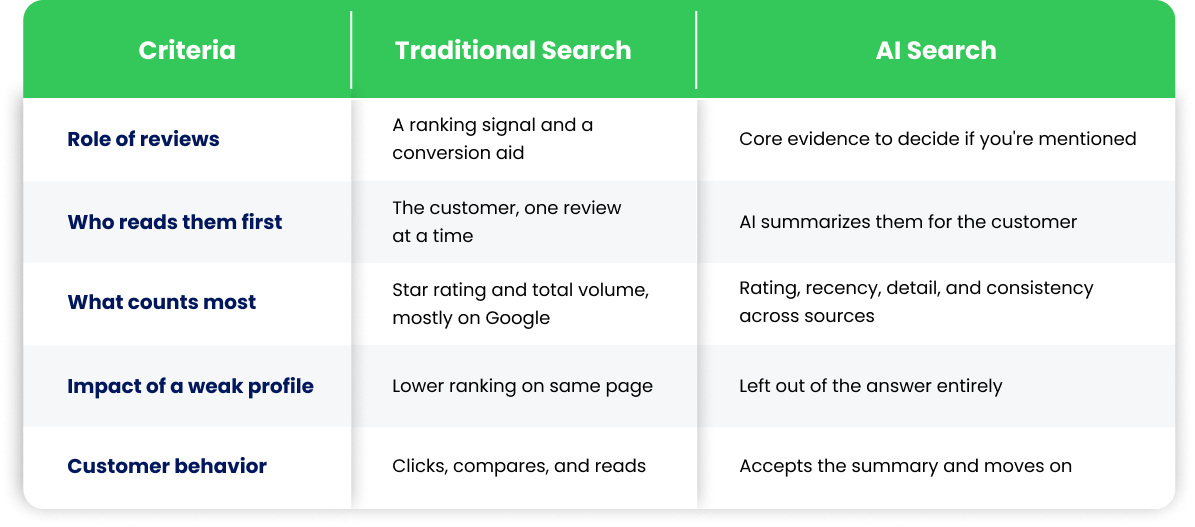
How reviews work in traditional search vs. AI search
Pro Tip
In traditional search, reviews can help you rank higher. In AI search, they can influence whether your business appears in the answer at all. Prioritize recent, specific, and consistent reviews across trusted platforms to strengthen your AI visibility.
Why reviews carry so much weight
Like traditional search engines, AI tools want evidence that a business is real, active, and trusted by actual customers before recommending that business. While a website may show a model what products and services you claim to provide, your reviews tell that same model what you actually do, directly from your customers.
Even before AI search hit full speed, reviews were a place where independent individuals frequently commented, often in excruciating detail, about their experiences with a business. This kind of engagement speaks directly to AI tools.
The world’s leading search engine has clarified the importance of reviews for visibility. Google’s Business Profile guidance states that a company’s Google review count and review score factor into its local search ranking. Moreover, the more reviews and positive ratings a business amasses can improve its local ranking.
As AI answers increasingly search for these same signals, a strong review footprint has become foundational rather than optional.
On the commercial side, the case for reviews was proven long before AI search hit the mainstream. A 2011 Harvard Business School study found that a one-star increase in Yelp rating drove a 5-9% jump in revenue for independent restaurants.
Another investigation, this time from Northwestern University’s Spiegel Research Center in 2017, found that having as few as five reviews causes a 4x increase in purchase likelihood. This effect was especially strong for higher-end products, where the conversion rate spiked 380% when reviews were displayed.
What makes a review valuable in AI search
Like most things, not all reviews are created equally. Wall-to-wall five-star ratings with no text tells AI systems very little about what your business is good at. Here are several qualities that make a review genuinely useful.
Specificity
AI systems want concrete details. Reviews that mention specific services, locations, employees, or problems solved are much more useful than a multitude of “Great service” reviews with no further explanation.
Recency
If your last review is from 2 years ago, something needs to change. A steady flow of new reviews outweighs a large archive of old ones, every time.
Breadth across sources
Google is still no.1 when it comes to search, but it’s not the only place AI systems (and customers) look. Industry directories, professional associations, and more niche review platforms all contribute to the overall picture of your reputation.
Credibility
Perfect scores can backfire. Research has shown that readers are often skeptical about reviews that are overwhelmingly positive. In many cases, negative reviews are seen as more credible, so a mix of feedback sometimes builds more trust than a suspiciously flawless profile.
Visible engagement
Google itself notes that engaging with customer feedback shows you value their feedback. Positive reviews that contain helpful replies can help you stand out from the crowd.
Pro Tip
Don’t panic over a handful of negative reviews. A calm, specific reply explaining what you did to fix the issue shows accountability, and this context travels with the review wherever it’s read, by a potential customer or an AI tool.
Building a review strategy for AI search
Almost every business is already collecting reviews in one way or another. The important strategic shift is treating them as a deliberate visibility channel rather than something simply happening in the background.
Audit where you’re being reviewed
Map out every platform on which your business is being discussed. That could be Google and industry directories, but it could also include forum sites like Reddit and Quora. Note your rating, the review volume, and the most recent review to identify the gaps you need to address.
Ask at the right moment
The best moment to ask for a review is immediately after a positive experience. Make it easy with a direct link and encourage customers to describe their experience in detail.
Respond to every review
Positive or negative, a reply signals that someone is paying attention. Keep responses personal and specific, because generic copy-and-paste replies add little and can look automated.
Make sure reviews and facts line up
If your reviews mention hours, locations, and services that do not match your listings, this inconsistency will create doubt. Update your business information everywhere it appears online to prevent this doubt from ever cropping up.
Stay firmly on the right side of the rules
Shortcuts are now a serious liability. The Federal Trade Commission’s final rule on consumer reviews from 2024 established the illegality of posting fake reviews, buying reviews, and hiding bad reviews, as well as making it clear that employee reviews must be presented as such.
Beyond the legal risk, fake or manipulated reviews undermine the very credibility that makes reviews valuable in the first place.
Measuring the impact of your reviews
Your star rating matters, but it’s just part of the story. Track a few more indicators to get a much better understanding of whether your reviews are helping or hindering your AI search success.
Review velocity tells you how many new monthly reviews you’re receiving, and thus, whether or not your profile is staying fresh. Rating by platform will highlight weak spots that could be undercutting your wider strategy. Similarly, recurring sentiment themes show you what multiple customers criticize and praise, which is something AI summaries tend to pick up on.
Finally, find out first-hand what AI tools are saying about you. Pose ChatGPT, Gemini, and Google’s AI answers the kinds of questions your customers regularly ask, and note whether you’re cited and how your reputation is described. If you don’t like the summary, your reviews are the first place to look.
Pro Tip: Conduct a quarterly audit of your reviews. Nowadays, there are businesses offering free GEO audits. AI tools refresh their sources, competitors work on their profiles, and a platform you may have overlooked last year could have become a key reference point since then.
Turn your reputation into a visibility advantage
Reviews have always granted us an insight into how a business treats its customers. In the era of AI search, they’ve become much more.
Reviews are some of the clearest signals of whether a business deserves to be recommended by AI platforms or not. The businesses that win aren’t always the biggest and don’t always have the biggest budgets. They’re the ones with fresh, detailed, honest feedback spread across a variety of places where AI tools and customers look.
Start treating your reviews as the growth channel they can be, and the next time a customer asks an AI platform which business they should choose, the answer will be yours.